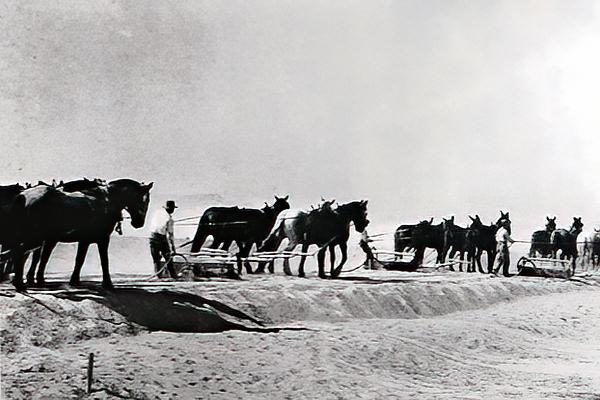
It is amazing to look back at the history of excavation over the past 100 years. What will the next 100 years bring?
The Operator
When I was a young man breaking into the trade, one of my mentors was an operator named Russ Phillips. It was the mid-1970s, and Russ was semi-retired, working part-time. He was tall and slim, with shoulders that leaned slightly forward from all the years pulling on levers. Over the years, his body had been shaped to fit the machines he ran. It was a job that demanded not only skill but strength. Russ had a calm, confident demeanor that had served him well, even as a teenager, when he first started moving earth with a Fresno and four around 1925. That's a Fresno scraper and four mules! He knew how to get along with mules as well as people, although at times he would comment about which could be more ornery.
Russ was a union man, and had spent most of his career as a skilled dragline operator — a tough machine to master. He had also worked as a fireman on steam shovels in his early years, and as a younger man helped to build the ports of Richmond and Oakland during WWII. His hands had touched nearly every era of earthmoving machinery, and the history of the trade lived in him.
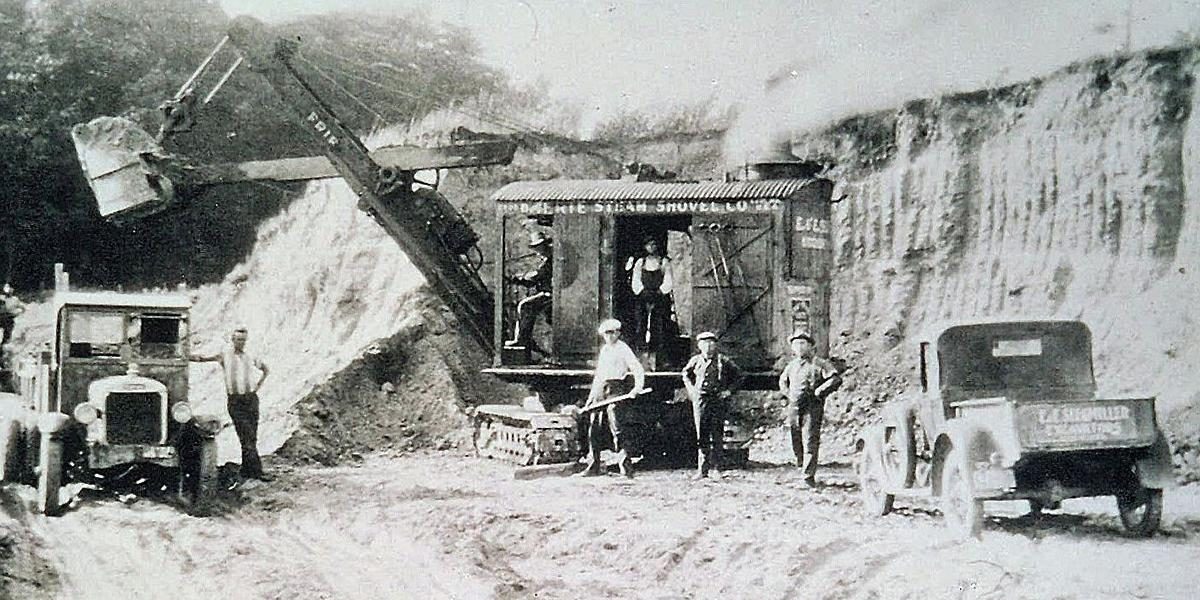
Steam, Coal, and the Work of 100 Men
One tale Russ told of the 1920s was about steam shovels. The operator and fireman would start early, well before the day's work began: cleaning the prior day's ash and clinker from the fire box … brushing the flues … watering the boiler and bunkers … shoveling coal … setting the fire and waiting for it to grow … topping off the steam oil cups … hitting all the grease zerks … once the fire was hot, waiting for the boiler to build steam … then, when the gauge finally read 80 psi — with the hiss of steam and thick smoke billowing from the stack — the rig was ready to work. Some days it took hours to prepare. But still, that steam shovel could do the work of 100 men.
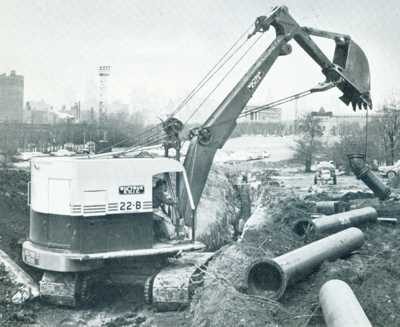
Then came diesel. In the mid-1930s, the transition from steam to internal combustion made the whole process simpler, though still ceremonial by today's standards. To start the day: fire up the gasoline-powered pony motor … ease the choke in … wait for it to warm up … engage the bendix … make sure the compression release is engaged … throw the clutch and get the big diesel spinning … wait for oil pressure to build … give her diesel … and when the exhaust changes from white to blue, there she goes! Let her warm up, gently work the frictions and brakes, and maybe 10 or 15 minutes later, she's ready for work.
With diesel came greater productivity, and the role of the fireman was made redundant. Scale, scope, and speed of work rapidly expanded — you could see it in the WWII-era building of ports and factories, and later in the construction of the Interstate Highway system. These shovels, with their drums of cable controlled by friction clutches and brakes, kept working well into the 1960s.
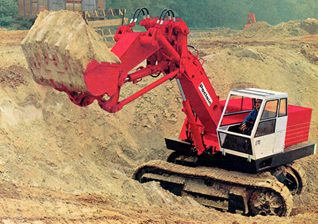
Then new, more productive and versatile hydraulic rigs, which replaced wire cables with flowing oil, began finding their way onto the jobsite. Russ had felt the competition as progress began to pass him. His mastery of pulling levers and controlling cables couldn't keep him ahead of the new machines. More and more work was going to the hydraulic rigs.
Keep Your Eye on the Cutting Edge
When I broke into the trade as an operator, I was working as a pick-and-shovel laborer and truck driver at a landscape contractor. Russ patiently gave me a chance to run different rigs on basic, simple tasks. His key advice: the secret to expertly operating a rig is to know where to look, where to focus your attention … keep your eye on the cutting edge. Sage advice that has stayed with me for over 35 years.
"The secret to expertly operating a rig is to know where to look, where to focus your attention … keep your eye on the cutting edge."
— Russ Phillips, c. 1975
The first backhoe I ran was a John Deere 410. Russ showed me the basic combination of levers to move the cutting edge, how to dig. In the morning, all you had to do was pull the dipstick to check the oil, turn the key, and start the rig up. All done in a couple of minutes — easy money compared to what Russ had described from the steam era.
In the beginning, I wasn't very good at pulling the levers in combination to run the backhoe smoothly, but I could load a truck with the front-end loader. I did well enough that my employer said if I could get into the Union, it was okay with him. With Russ' encouragement and advice, I found a way to join Local 3 of the Operating Engineers and was dispatched out as an A-card journeyman, skipping a formal apprenticeship.
I lost track of Russ when I was laid off during the economic downturn around 1979. Because I wasn't formally recognized as an apprentice with the Union, I was cut off from the education and mentorship that a formal apprenticeship would have afforded. My future path as an operator was uncertain — my skills were not yet up to true journeyman level.
Russ had shown his pride in being a Union man, and I wanted to follow in his footsteps. The long-term continuity and stability of the Union had given Russ the confidence to mentor me, knowing that doing so would strengthen the craft and the Union itself. It was a way for him to pay it forward. I wanted to live up to his confidence in me. And to be perfectly honest — I loved running machines.
What saved me was the CAT 245 excavator, which had begun arriving on construction sites a few years earlier. Because of its large 45-ton size, Union work rules required an oiler to assist the operator — a holdover from the days of cable rigs, where it took two hands to run a large machine. This also protected the oiler assistants who were being made redundant as the cable rigs were phased out.
I got to know the dispatcher at the Union Hall pretty well. As contractors brought the big excavators to the district, I would often get dispatched to work as an oiler. That opportunity to work around the big machines gave me the chance to, bit by bit, build up my skills. I learned how to move the rig around the jobsite, check grade with a hand level and folding ruler, then how to lay out work — and sometimes even to pull the levers and do a bit of digging.
This kept me busy, and because my benefits were portable from one contractor to the next, I was building hours with the Union toward my family's medical coverage and my future pension. (Which was a good thing, as my second child was on the way.)
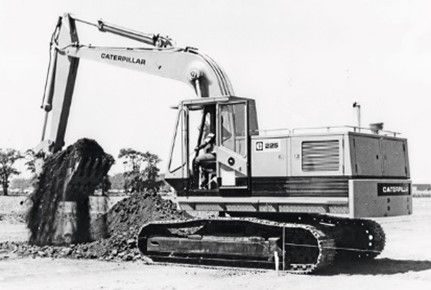
The first time I got a full-time seat was on a smaller, new CAT 225 — still a fairly large machine by today's standards, weighing around 25 tons. I still remember the cab: long wobble-stick lever controls hooked to the hydraulic pilot system. The seat was comfortable, but the cab had the barest of amenities — an ashtray and a heater. The engine was loud, and each time the dipper stick pulled hard into the dirt, the engine would grunt under load and belch a puff of black diesel smoke from the exhaust stack. I was as happy as a man could be.
I went on to have a long and productive career. I learned to master not only excavators but many other types of dirt equipment and cranes. I'm proud that I also had the opportunity to mentor many apprentices and pay it forward to the next generation — just as Russ had done for me.
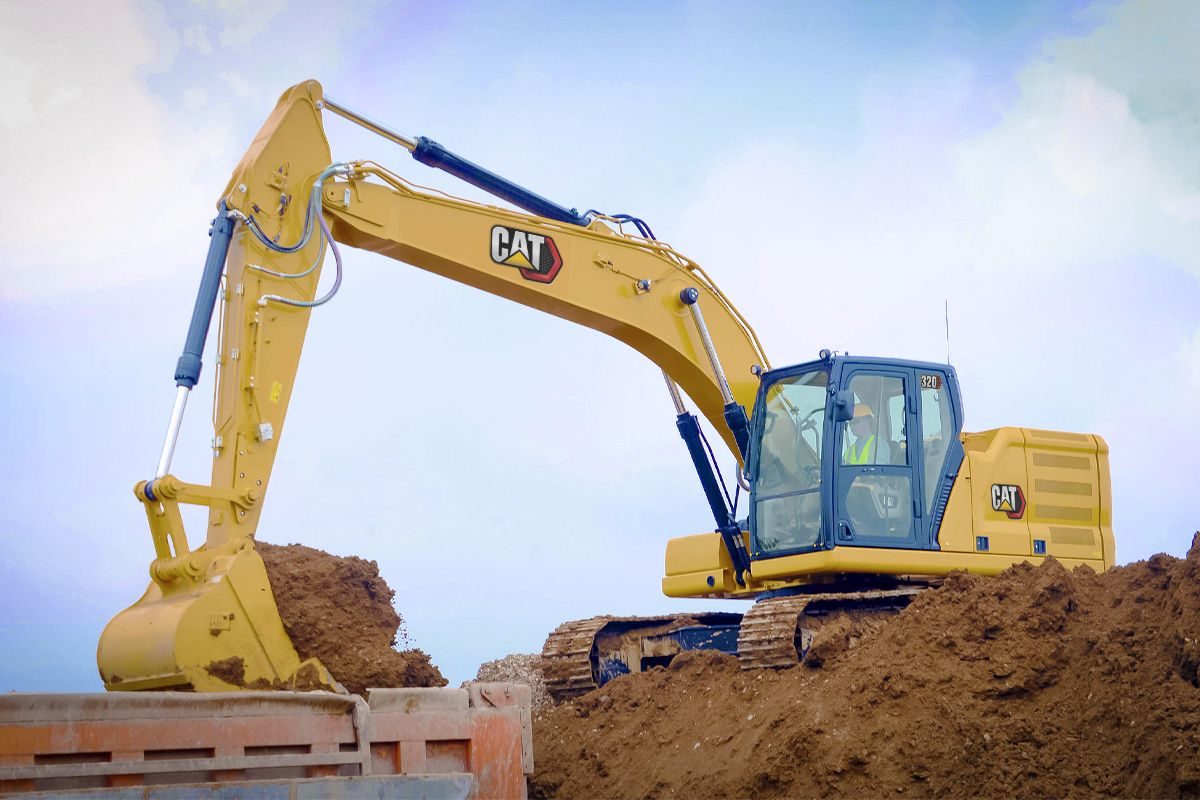
When I retired about 10 years ago, the excavators I was running were in a different league from those at the beginning of my 35-year career. Powerful, clean-running engines. Smooth, precise hydraulics with computer-controlled fly-by-wire joysticks. A safe, quiet, climate-controlled cab with robust rollover protection. To start up a modern excavator today, you sit in the cab, turn on the power, and wait for the computer to boot. Check that there are no warning messages on the display screen, and start her up — ready to work in less than 30 seconds.
In the span of 100 years, the excavator has evolved from steam power to a highly productive, versatile, and comfortable machine. From big to small, excavators have taken over and are everywhere.
Knowledge, Capital, and the Thinking Machine
Looking back across my career, what strikes me most is not just how much the machines changed — but how the knowledge built into them progressed. Every improvement to an excavator, from the steam shovel to the CAT 245 to the fly-by-wire machines I retired on, represented a refinement of embedded knowledge: engineering insight, hard-won experience, and accumulated technique locked into the physical design of the rig itself.
This idea of accumulated, value-generating assets — of embedded knowledge made tangible — is what economists call capital. While most people assume the word means only money, it is, in fact, something broader: any asset or resource that can be used to generate value over time — anything that contributes to production.
The classical definition comes from a simple distinction. The factors of production are land, labor, and capital. Land provides raw materials and space. Labor provides human effort and time. Capital is what is left: the tools, machines, buildings, knowledge, and systems that make labor more productive than it would be on its own.
Three Kinds of Capital
- Physical Capital
- The machine itself — every design improvement from the steam shovel's boiler to the fly-by-wire joystick is accumulated knowledge made tangible.
- Knowledge Capital
- The geometry of the boom, the hydraulic circuit, the cab ergonomics — crystallized thinking from generations of engineers and operators.
- Human Capital
- The skill and judgment of the operator who brings the machine to life. Experience that lives in the hands and body, not in any manual.
What made every technology transition in this industry work — from cable to hydraulic, from analog to computer control — was the interplay between the knowledge embedded in the machine and the knowledge carried in the operator's hands. It was a conversation, conducted over decades, between human skill and physical capital.
A New Form of Capital
The move to AI changes the nature of that conversation in a fundamental way. With every previous technology, the embedded knowledge lived entirely in the physical realm — in steel, hydraulics, circuitry. You could touch it, service it, understand it by taking it apart. AI moves the embedded knowledge into a different realm: the realm of learned behavior, of weights and training data, of pattern recognition that no human fully wrote and no manual fully explains. The AI guided machine still moves dirt. But the knowledge that guides it is no longer entirely physical. It has become cognitive.
This raises a question that will define the next chapter of this industry: how far, and how fast, can that cognitive capital substitute for the human operator — and what does the human operator become in the meantime? In the near term, the answer is clear. A robotic excavator without close human coordination is not yet a practical reality. The most productive near-term systems will be collaborative ones: human and machine working together, each contributing what the other cannot.
A New Player Enters the Jobsite
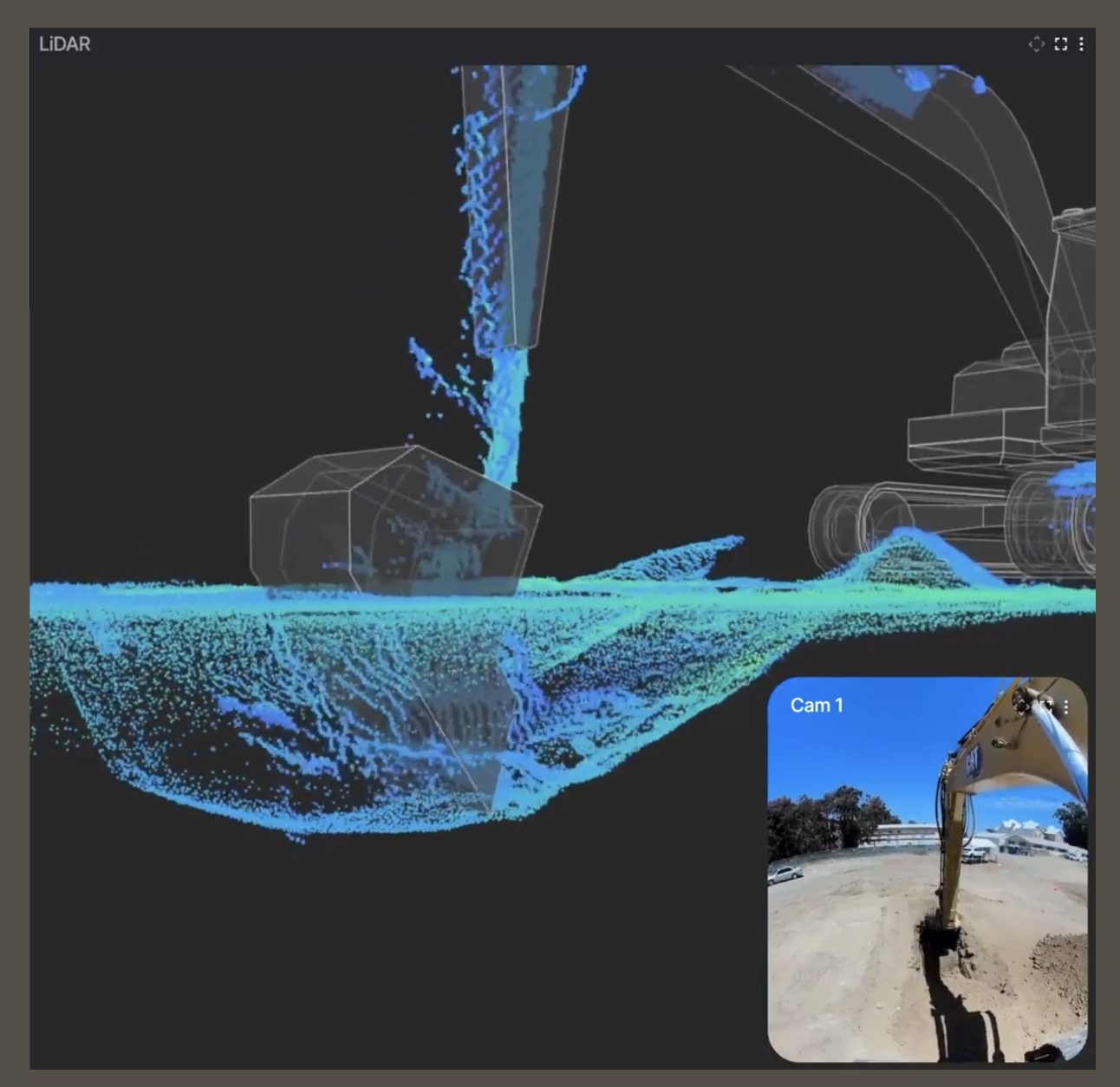
The traditional players in the construction industry — contractors, clients, equipment manufacturers, and operators — are now being joined by a new player: AI-based robotics companies. Northern California is one of the premier centers for this transformational technology. Companies like Pronto, Bedrock, Built, and Kodiak are joining the majors such as Caterpillar and Komatsu in working to bring AI-powered automation to construction equipment.
At these companies and the labs developing AI, one of the central questions is alignment — ensuring that AI systems behave in ways that are consistent with human intentions, values, and goals. And right now, in the construction industry, that question of alignment has a very concrete meaning: how do AI and robotics companies engage with the workers and unions whose knowledge, skill, and labor will determine whether this technology succeeds or fails?
An Obligation to Get This Right
There is a question that sits beneath all the economic arguments and all the technology forecasts, and it deserves to be named plainly: what do we owe each other?
The knowledge required to operate an excavator well is not in any manual. It lives in the hands and the body of the operator — in the feel of the machine under load, the thousand micro-adjustments that separate a journeyman from a master. When an AI company uses that knowledge as training data, something of real value is being transferred. The only ethical question is whether that transfer is recognized and compensated, or simply taken.
"AI will almost certainly grow the overall pie. But a bigger pie means nothing to the worker who receives no slice."
— Justin Wolfers, University of Michigan
History has seen this before. Every major wave of automation has carried with it a choice: share the gains with the people whose labor made them possible, or concentrate them at the top and leave the workers behind. Nobel laureates Daron Acemoglu and James Robinson argue in Why Nations Fail that extractive institutions ultimately destroy the very prosperity they appear to generate. The warning applies to industries and companies just as much as nations.
What We Owe Each Other — In Practice
So what does it actually mean to do right by the workers whose industry is being transformed? It means specific commitments:
- Recognize that operator skill is intellectual property. When a master operator's movements become training data for an AI system, that person is contributing something irreplaceable. The right thing — not just the smart thing, the right thing — is to compensate that contribution fairly.
- Protect the apprentice pathway. Entry-level work as the foundation of mastery is exactly what automation threatens to eliminate first. An ethical approach to automation asks: where will the next generation of skilled operators come from?
- Create new roles with the same dignity as the ones being displaced. The operators who can work alongside automated systems, who understand both the machine and the algorithm, are more valuable, not less.
- Build for resilience, not just efficiency. A fully automated jobsite is a jobsite that goes dark when the power fails. In a natural disaster, human skill is not a redundancy — it is a necessity.
Labor, Capital, and the Long View
"Labor is prior to, and independent of, capital. Capital is only the fruit of labor, and could never have existed if labor had not first existed. Labor is the superior of capital, and deserves much the higher consideration."
— Abraham Lincoln
The construction industry needs a skilled, stable workforce. Unlike most other industries, construction is project-based — when a project is complete, the worker moves on to the next one. The Operating Engineer Union, Local 3 in particular, has served to provide continuity, stability, and mobility to this skilled workforce. This benefits the contractor by ensuring access to skilled and motivated workers, and it benefits the worker by providing portable benefits — health care, pension — that follow them between employers.
That long-term stability was exactly what gave Russ the confidence to mentor me — knowing that doing so would only strengthen the Union and secure his own place within it. The same dynamic needs to hold as AI enters the picture. A healthy relationship between workers and the companies building and implementing automation technology is not just good ethics; it's good business.
Questions to Keep Our Eyes on the Cutting Edge
Acemoglu and Robinson remind us that history turns on "critical junctures" — moments when the path forward is genuinely open, and small decisions have outsized consequences. The arrival of AI in construction is one of those junctures. Get it right, and the productivity gains could be shared broadly. Get it wrong, and the industry risks a race to the bottom. The key questions:
- How do AI and robotics companies, workers and their Unions engage with and strengthen the existing workforce system — rather than undermine it — as automation reshapes the work?
- Where do new and apprentice operators grow their current and future skills if automation removes the entry-level tasks that have always served as the learning ground?
- If expert operators are the source of AI training data, who owns that knowledge — and how do skilled workers share in the value it creates?
Just One Final Thought …
In the Local 3 Master Agreement, it states that the employer is the sole judge of the qualifications of the employee. This demands that to remain competitive, the worker must have the skills to get the job done. That principle — that merit should be rewarded, that skill should be recognized, that the person doing the work deserves a fair return for doing it well — is not just a contractual rule. It is a moral one.
The arrival of AI does not change that foundation. It tests it. The question is not whether automation will come — it will, just as diesel replaced steam and hydraulics replaced cable. The question is whether the people building these systems have the character to do it right.
If you are early in your career right now, you are going to live through a transformation as significant as the one Russ witnessed — from mules to steam, from cable to hydraulic, from analog to AI. Learn the machines. Learn the algorithms too. The operator who understands both will be indispensable. Russ paid it forward to me, and I strove to pay it forward to the apprentices who came after. That chain of obligation — one generation to the next, one operator to the one still learning — is what this industry runs on. Keep your eye on the cutting edge. Don't break the chain.